Concrete Foundation Options for Utah's Expansive Clay Soils
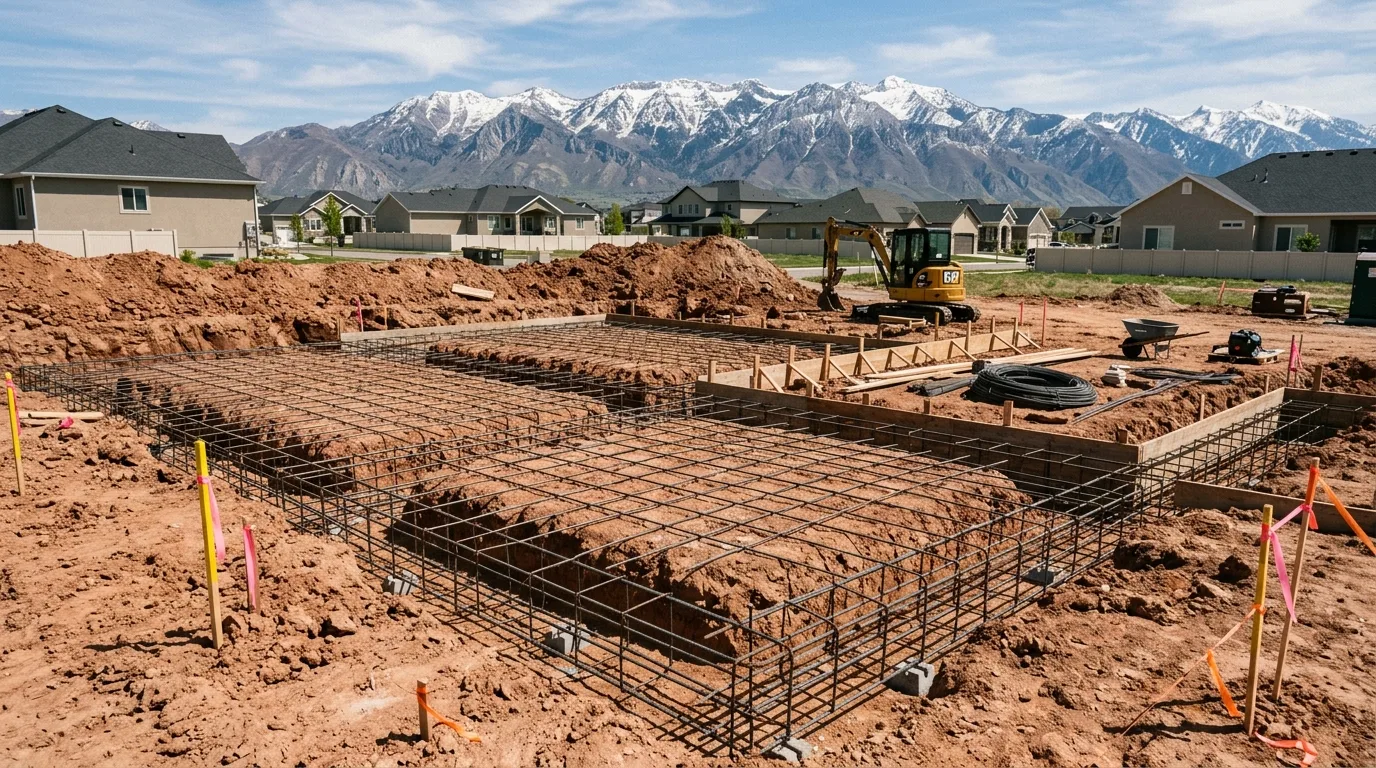
Riverton requires lot-specific soils reports on all new single-family dwelling permits — a requirement that reflects the genuine engineering challenge posed by Salt Lake County’s expansive clay soils. If you’re building a new structure on a Riverton property, understanding your foundation options before breaking ground will save you from expensive remediation later. This guide explains what’s available, what the soils conditions mean for each option, and how to make the right choice for your site.
Questions About Foundation Options in Riverton?
Call Riverton Concrete at (888) 376-0955 for a consultation on your specific site and project.
Why Riverton’s Soils Make Foundation Design More Complex
The clay-heavy soils underlying much of Riverton’s residential areas — including the Heritage Farms, Rose Creek, and Midas Creek neighborhoods — are classified as expansive. Unlike sandy or gravelly soils that maintain relatively stable volume with changes in moisture content, these clays swell significantly when they absorb water and shrink when they dry. Volume changes of 10 to 20% are not uncommon in Utah’s high-plasticity clays.
This seasonal soil movement applies forces to foundations from below and from the sides — forces that conventional slab-on-grade designs without proper reinforcement cannot resist. The result is differential settlement (one part of the foundation sinks while another rises), which produces the diagonal cracking in walls and sticking doors that homeowners notice years after construction. Addressing this problem at foundation design time costs far less than structural repairs after the fact.
Types of Concrete Foundations for Riverton Conditions
Conventional slab on grade: A flat concrete slab poured on compacted fill and base material. Appropriate for sites with low-to-moderate expansive soil potential where the soils report indicates stable bearing conditions. Minimum 4 inches thick, reinforced with #4 rebar. The least expensive option when soil conditions are favorable.
Thickened slab on grade: Same as conventional slab but with a thickened perimeter and interior beams poured as part of the slab. The thickened sections provide additional stiffness and load path to resist differential movement. More common in Riverton than in lower-clay-potential markets.
Post-tensioned slab: High-strength steel tendons are positioned in the slab before pouring. After the concrete reaches adequate strength, the tendons are stressed to a predetermined force, putting the entire slab in compression. This compression counteracts the tensile stresses that soil movement creates — allowing the slab to bridge over soil irregularities rather than cracking under them. Increasingly used on Riverton residential construction where soils reports indicate moderate-to-high expansive potential.
Waffle slab: A raised slab system with a grid of concrete beams on the underside. The beams create an air gap between the slab and the native soil, isolating the slab from direct soil contact and reducing the uplift forces transmitted to the structure. Common in Texas and other high-clay markets, and increasingly used in Salt Lake County’s most challenging expansive soil sites.
Drilled pier and grade beam: Concrete piers are drilled below the active moisture zone (below the depth where seasonal moisture changes occur), and grade beams spanning between piers support the structure. The piers anchor below the soil’s active movement zone, stabilizing the structure regardless of what the upper soil layers do. Most expensive option but appropriate for high-risk expansive soil sites or steeply sloped lots near Riverton’s eastern bench areas.
Practical Considerations for Riverton Foundation Projects
-
Soils report is mandatory: Riverton City requires a lot-specific soils report for all new dwelling permits. The report will classify your site’s soil type, expansion potential, and recommended foundation system. The engineer’s recommendation in the soils report should drive the foundation design decision.
-
Frost depth requirements: Footings in Riverton must be placed below the frost line — typically 24 to 30 inches — to prevent frost heave from lifting foundation elements. Failure to meet frost depth is a common cause of foundation movement in accessory structures built without proper engineering.
-
Drainage is as important as foundation type: Any foundation in Riverton requires positive drainage away from the structure — a minimum 6-inch drop in the first 10 feet of grade. Water accumulating against the foundation is the primary driver of expansive soil damage because it cycles the soil between wet and dry conditions repeatedly.
-
Base material quality: For slab systems, the quality and compaction of base material is as important as the slab itself. We use Class 6 compacted road base, placed in controlled lifts and compacted to 95% standard Proctor density. This is not an area to cut corners.
Planning a Foundation or Slab in Riverton?
Riverton Concrete coordinates soils reports, permits, and installation. Call (888) 376-0955.
How Foundation Work Is Sequenced in Riverton
After the soils report is received and reviewed, we work with the property owner and any structural engineer of record to confirm the foundation design. The Riverton building permit application includes the soils report and structural plans. After permit issuance (typically 1 to 3 weeks), excavation begins.
For slab-on-grade projects, excavation is followed by base preparation and compaction, forming, reinforcement placement, and the concrete pour. For post-tensioned systems, tendon installation is an additional step before pouring. The slab is poured, finished, and cured before framing begins — typically 7 days for frame-bearing loads, 28 days for full strength.
Cost of Concrete Foundations in Riverton
Standard slab on grade in Riverton costs $6–$11 per square foot complete. Post-tensioned slabs add $1.50–$3.00 per square foot for tendon materials and stressing. Drilled pier and grade beam systems are priced on a project-specific basis but typically cost 40 to 80% more than a comparable slab-on-grade.
A 1,200-square-foot conventional slab costs $7,200–$13,200. The same area in post-tensioned concrete costs $9,000–$16,800. The premium for post-tensioned is almost always worth it on Riverton sites with moderate-to-high expansion potential.
Frequently Asked Questions
Does every Riverton property require a soils report?
Riverton City requires lot-specific soils reports for all new single-family dwelling permits. Accessory structure pads below certain size thresholds may not require a soils report. We advise on applicable requirements during the estimate process and coordinate soils report procurement when needed.
Can I build on a Riverton site with high-expansion soils?
Yes — high-expansion soil conditions require more robust foundation design, not avoidance. Post-tensioned slabs, drilled piers, or waffle slab systems are specifically engineered for these conditions. The soils report will identify the appropriate system, and we can execute any of these options.
How do I know if my existing foundation is affected by expansive soil movement?
Common signs include diagonal cracks running from window and door corners, doors and windows that stick or don’t close properly, visible separation between walls and floors, and cracks in exterior stucco or brick. These symptoms don’t always indicate serious structural damage, but a structural engineer’s assessment is warranted before deciding on remediation.
Build Your Riverton Foundation Right the First Time
Call Riverton Concrete at (888) 376-0955 for foundation consultation, permit coordination, and expert installation.
Related: