How Utah's Freeze-Thaw Cycles Affect Concrete in Riverton, UT
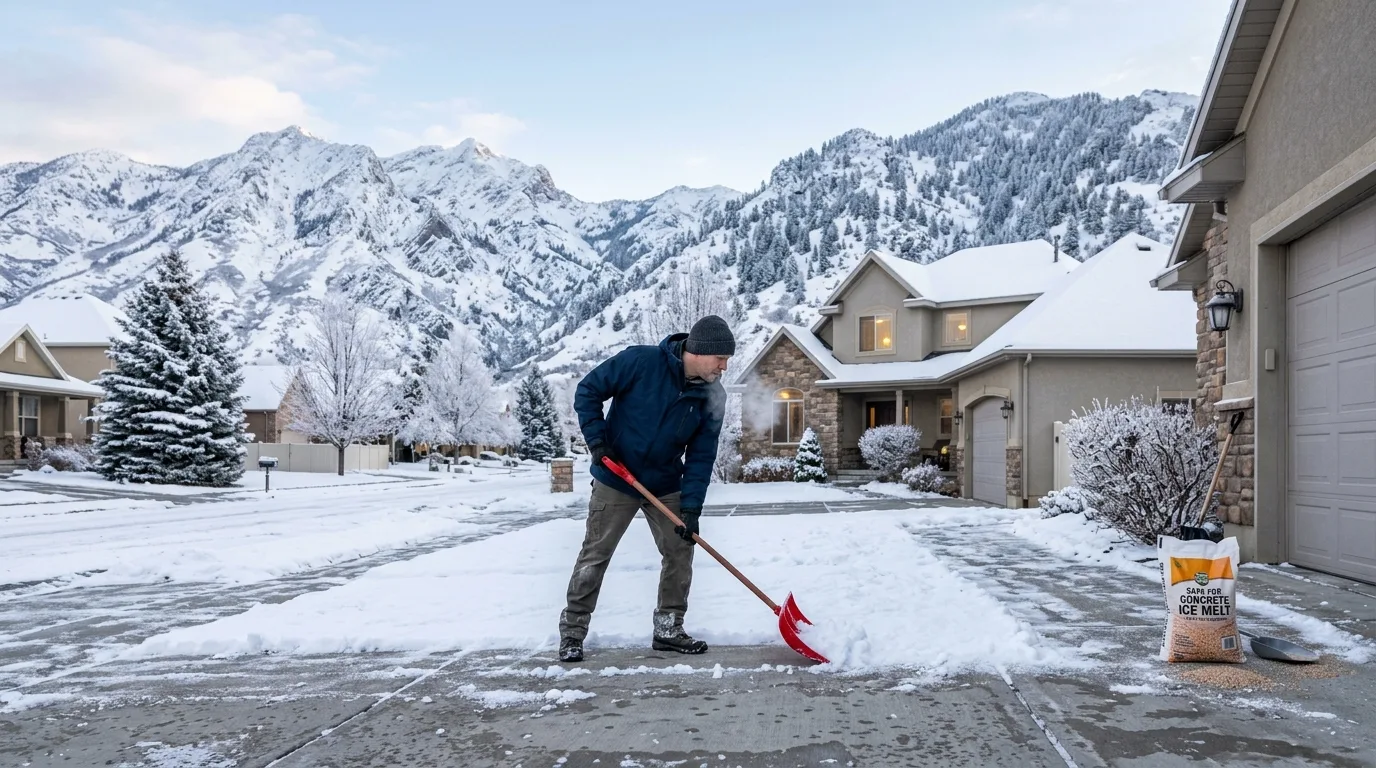
By early April in Riverton, many homeowners notice new cracks in their driveways, patios, and sidewalks that weren’t there the previous fall. The cause isn’t poor workmanship or bad luck — it’s physics. In this post, we explain exactly what freeze-thaw cycling does to concrete and what Riverton homeowners can do to prevent it.
Protect Your Riverton Concrete Before Next Winter
Call Riverton Concrete at (888) 376-0955 to schedule a concrete assessment or sealing service.
Why Freeze-Thaw Cycles Matter for Riverton Concrete
Riverton experiences a semi-arid four-season climate with an important characteristic: from November through March, daily temperatures frequently oscillate above and below 32°F. The average daily high might be 38°F while the overnight low drops to 18°F — creating a crossing of the freezing threshold twice per day, sometimes more. When you multiply this by approximately 60 to 90 days per winter season, Riverton concrete surfaces experience dozens of complete freeze-thaw cycles per year.
The physics is straightforward. Water expands by approximately 9% when it freezes. Water infiltrating concrete pores — either from precipitation, snowmelt, or capillary rise from saturated soil — freezes in those pores and applies hydraulic pressure against the surrounding cement matrix. A single freeze-thaw cycle may not produce visible damage, but after five to ten cycles, micro-fractures develop. After twenty to forty cycles over several winters, those micro-fractures merge into the surface scaling, spalling, and cracking that Riverton homeowners discover each spring.
This damage pattern is visible throughout the Heritage Farms and Midas Creek neighborhoods — older driveways show progressively worsening surface deterioration precisely because the concrete wasn’t specified with freeze-thaw conditions in mind.
Types of Freeze-Thaw Damage in Riverton
Surface scaling: The top 1/8 to 1/4 inch of the slab surface flakes away, exposing the aggregate below. Most often seen on driveways where de-icing salt use intensifies freeze-thaw damage. Salt lowers the freezing point of water, causing more intense cycling in the concrete surface layer.
Spalling: Larger chunks of surface concrete break away, creating rough, pitted surfaces. More advanced than scaling — indicates that freeze-thaw damage has penetrated deeper into the slab.
Pattern cracking: A network of interconnected cracks across the surface, sometimes called map cracking or crazing. Often caused by a combination of freeze-thaw cycling and inadequate curing during initial installation.
Crack widening: Existing cracks widen as water infiltrates and freeze-thaw pressure acts as a wedge. A 1/8-inch crack left untreated through one winter can easily reach 1/4 inch or wider.
Practical Steps to Protect Riverton Concrete
-
Specify air-entrained concrete: Air-entrained mixes contain 4 to 7% entrained air — microscopic bubbles distributed throughout the mix that provide relief points for freeze-thaw expansion pressure. This is the single most important specification for any outdoor concrete in Salt Lake County.
-
Seal before winter: A penetrating silane/siloxane sealer blocks moisture infiltration at the surface level, reducing the water available to freeze inside pores. Apply to driveways, patios, and sidewalks before the first hard freeze — September or October in Riverton.
-
Repair cracks promptly: Cracks allow direct water infiltration, accelerating damage with every freeze-thaw cycle. A small crack repaired in October costs a fraction of what a widened, undermined crack costs to address the following spring.
-
Reduce de-icing salt use: Sodium chloride and calcium chloride accelerate surface scaling dramatically. Use sand or kitty litter for traction instead. If chemical ice melt is necessary, calcium magnesium acetate is far less damaging.
-
Maintain proper drainage: Water pooling on or near concrete slabs increases moisture infiltration. Keep downspout extensions directing water away from slabs, and address any grade conditions causing water to pond near driveways or patios.
Is Your Riverton Concrete Ready for Winter?
Schedule a sealing or repair service with Riverton Concrete before the next freeze season.
How Freeze-Thaw Damage Compounds With Riverton’s Soils
Homeowners across Salt Lake County face a compounding problem: freeze-thaw damage above the slab and expansive clay movement beneath it. Riverton’s clay-heavy soils absorb snowmelt and spring rain, swelling upward against slab bottoms. When the soil dries out in summer, it contracts and pulls away from the slab, creating voids. This combination of upward pressure in wet conditions and loss of support in dry conditions accelerates cracking in slabs that aren’t adequately reinforced and supported by compacted base material.
The result is a pattern commonly seen in the Rose Creek and Foothills neighborhoods: driveways that look good for three to five years and then deteriorate quickly because both the surface and the subgrade are working against the slab simultaneously. Addressing this requires both proper mix specification at installation and appropriate subbase preparation — not one or the other.
Cost of Concrete Repair vs. Prevention in Riverton
Sealing a 600-square-foot driveway with a quality penetrating sealer costs $300–$600 — roughly $0.50–$1.00 per square foot. Repairing surface scaling and spalling damage costs $6–$12 per square foot or more, depending on depth and extent. Full driveway replacement costs $6.50–$10.00 per square foot for a standard pour. The math strongly favors prevention.
Read our concrete repair vs. replacement guide to understand when each option makes sense for your situation.
Frequently Asked Questions
Does all concrete crack from freeze-thaw cycles in Riverton?
No — properly specified air-entrained concrete with a well-maintained sealer resists freeze-thaw damage effectively. Most of the cracking and spalling seen across Riverton’s older neighborhoods reflects concrete that was either not air-entrained or was never sealed. Concrete installed in the last 15 to 20 years with proper specifications tends to perform significantly better through Utah winters.
Is Riverton’s freeze-thaw problem worse than other Salt Lake Valley cities?
Riverton’s elevation (4,439 feet) and southwest Valley location mean it experiences freeze-thaw cycles similar to neighboring Herriman and Bluffdale — somewhat more severe than lower-elevation cities like Salt Lake City proper. The combination of elevation, clay soils, and daily temperature swings makes freeze-thaw specification particularly important for Riverton concrete work.
When should I check my concrete for freeze-thaw damage?
Late March and April — after winter’s freeze-thaw cycles are complete and snow has melted — is the best time to inspect Riverton concrete for new damage. Look for new cracks, surface scaling, and any sections that have shifted or settled. Address damage before the next winter season whenever possible.
Schedule a Concrete Assessment Before Next Freeze Season
Call Riverton Concrete at (888) 376-0955 for an honest assessment and repair options.
Related: