Concrete Repair vs. Replacement in Riverton, UT: When to Fix vs. Replace
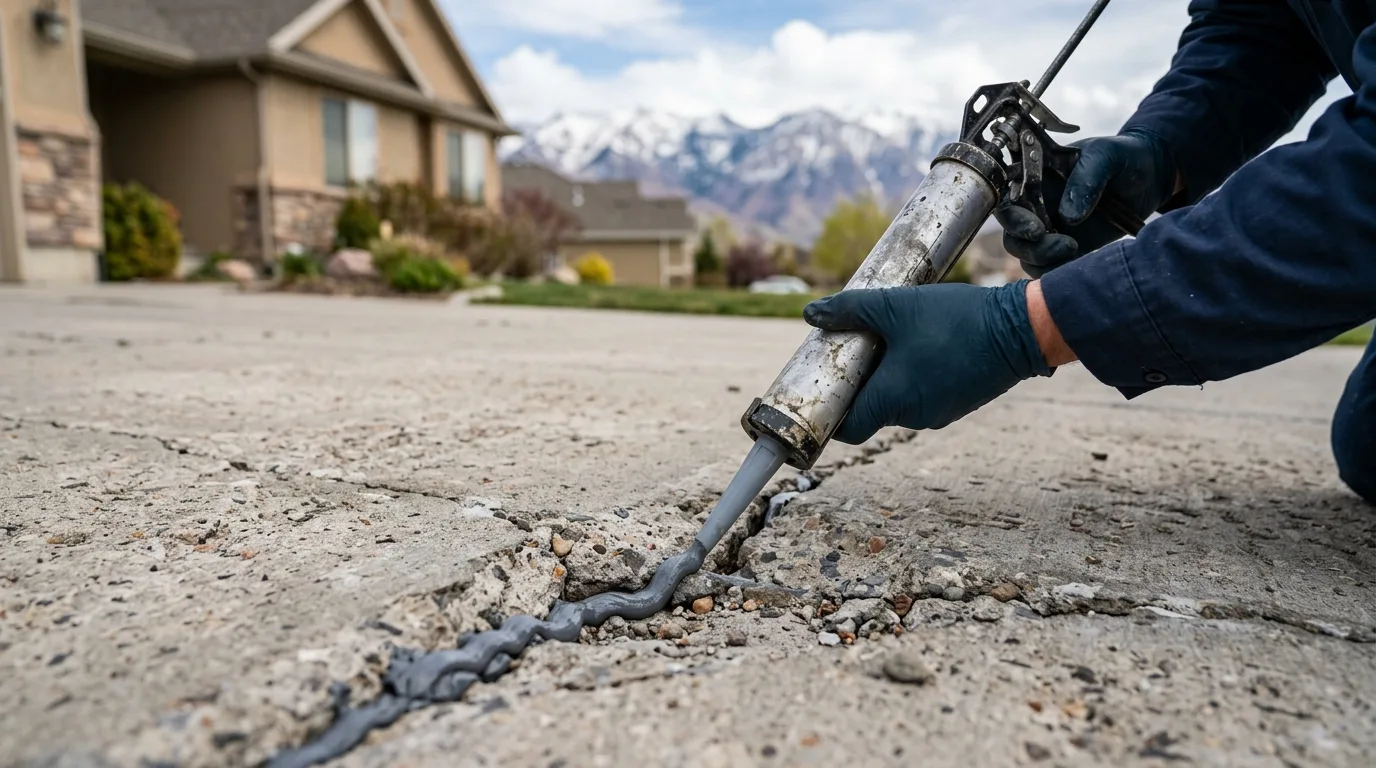
How do you know when your Riverton driveway or patio needs repair versus full replacement? This is one of the most common questions homeowners ask after inspecting their concrete each spring, and the answer isn’t always obvious. In this post, we provide a practical decision framework based on damage type, severity, and the cost-effectiveness of each option in Riverton’s market.
Not Sure If You Need Repair or Replacement?
Riverton Concrete offers free, honest assessments. Call (888) 376-0955 to schedule one.
Why the Repair vs. Replacement Decision Matters in Riverton
Each spring, Salt Lake County homeowners find new damage after winter. Many go straight to replacement quotes when targeted repair would solve the problem for 20 to 30% of the cost. Others get repair quotes for damage that genuinely requires replacement — and end up spending money on work that fails within two years, then facing the replacement they should have done initially.
The right answer depends on three factors: the type of damage, its extent and depth, and whether the underlying cause can be addressed by repair rather than full demolition and reinstallation.
Types of Damage and What They Mean
Surface scaling: The top 1/8 to 1/4 inch is flaking away, exposing aggregate. This is cosmetic-to-moderate damage — a good candidate for repair through resurfacing if the underlying slab is structurally sound. If scaling covers more than 50% of the surface and is 1/4 inch or deeper, replacement may be more cost-effective.
Spalling: Larger chunks breaking away from the surface. Moderate to significant damage. Repair is viable if confined to limited sections; widespread deep spalling on slabs over 20 years old suggests replacement.
Surface-level hairline cracks: Very fine cracks, less than 1/16 inch wide. Repair by filling with concrete crack sealant and sealing the surface. These are maintenance issues, not structural concerns.
Moderate cracks (1/8 to 1/4 inch): Fill with polyurethane or epoxy injection. If the underlying cause — drainage problem, expansive soil movement — is addressed, these repairs hold for years.
Wide or through-cracks (over 1/4 inch): More serious. If cracks extend through the full slab depth, especially in multiple locations, structural integrity is compromised. Evaluate whether mudjacking can stabilize the slab first.
Settled or heaved sections: Sections have dropped or risen more than 1 inch. Mudjacking ($4.55–$5.83 per square foot) can often restore grade for isolated settled panels. Multiple settled panels or settlement that continues returning suggests drainage or subbase issues requiring more extensive work.
Practical Scenarios: Repair vs. Replace
-
Single driveway panel cracked across full width: Repair viable — saw-cut the crack, fill with flexible sealant, and monitor. If the panel is also settled by more than 1 inch, mudjack before sealing.
-
Widespread surface scaling on 20-year-old driveway: Repair viable — apply a bonded overlay or resurfacing system. This buys 8–12 more years at 20–30% of replacement cost. If the slab is structurally sound with minimal cracking below the scale, resurfacing makes economic sense.
-
Multiple through-cracks on 30-year-old driveway: Replacement typically better. A slab this age likely lacks modern reinforcement and freeze-thaw resistant mix. Patching repeatedly on an aging, under-reinforced slab costs more than replacement over 5 years.
-
Patio with cracked control joints: Normal. Control joints are designed to crack in a controlled location — this is not a defect. Fill with flexible joint sealant to prevent water infiltration.
-
Settled patio sections in the Herriman or Bluffdale areas: Mudjack first, then seal. If settlement recurs within 2 years, the subbase drainage issue requires addressing before the slab can be stabilized.
-
Foundation slab with heaved sections: Seek structural engineering review before acting. Expansive soil pressure on foundation slabs in Salt Lake County is a different problem from residential flatwork and may require geotechnical intervention.
Get an Honest Assessment for Your Riverton Property
We never recommend replacement to sell a larger job. Call (888) 376-0955 for a free evaluation.
Cost Comparison: Repair vs. Replacement in Riverton
Crack filling: $100–$400 per crack depending on length and depth.
Resurfacing overlay: $3–$7 per square foot for a thin bonded overlay system. A 600-square-foot driveway: $1,800–$4,200.
Mudjacking: $4.55–$5.83 per square foot. A 400-square-foot settled driveway: $1,820–$2,332.
Full replacement: $6.50–$10.00 per square foot for a standard 4-inch reinforced slab. A 600-square-foot driveway: $3,900–$6,000 before demo.
Demo and replacement combined: $10.50–$18.00 per square foot total. A 600-square-foot driveway: $6,300–$10,800.
The break-even point where replacement beats repair is typically when repair cost exceeds 40 to 50% of replacement cost AND the remaining slab life is less than 10 years.
How the Process Works
For repair projects, we begin with a site assessment to diagnose root cause. Surface-only damage proceeds directly to repair. Structural concerns — settled sections, widespread cracking — require subbase investigation before recommending repair or replacement. For replacement projects, we provide full-scope quotes including demolition, base preparation, concrete, and finishing.
Frequently Asked Questions
Can I repair just part of my driveway and match the existing concrete?
Yes — we can saw-cut and replace specific panels. The new concrete won’t match the existing color and texture exactly at first, but weathers to a similar appearance over 1 to 2 years. If exact match is critical, full replacement is the only way to achieve it.
How long do concrete repairs last in Riverton?
Repairs that address the root cause — drainage, subbase voids, expansive soil movement — last 5–15 years depending on method. Repairs that treat only the surface without addressing root cause often re-fail within 1 to 2 winters. We only recommend repairs we expect to hold. Learn more about how freeze-thaw cycles affect Riverton concrete.
Should I repair before selling my Riverton home?
Generally yes — obvious concrete damage reduces buyer confidence and may show up in home inspection reports. A targeted repair at $1,500–$3,000 typically returns more than its cost in buyer confidence and negotiating position. Full replacement is rarely necessary for sale unless the concrete is functionally unsafe or extremely deteriorated.
Repair or Replace? Let's Figure It Out Together
Riverton Concrete gives honest recommendations. Call (888) 376-0955 for a free assessment.
Related: