RV Pad Concrete in Riverton, UT: Costs & Requirements
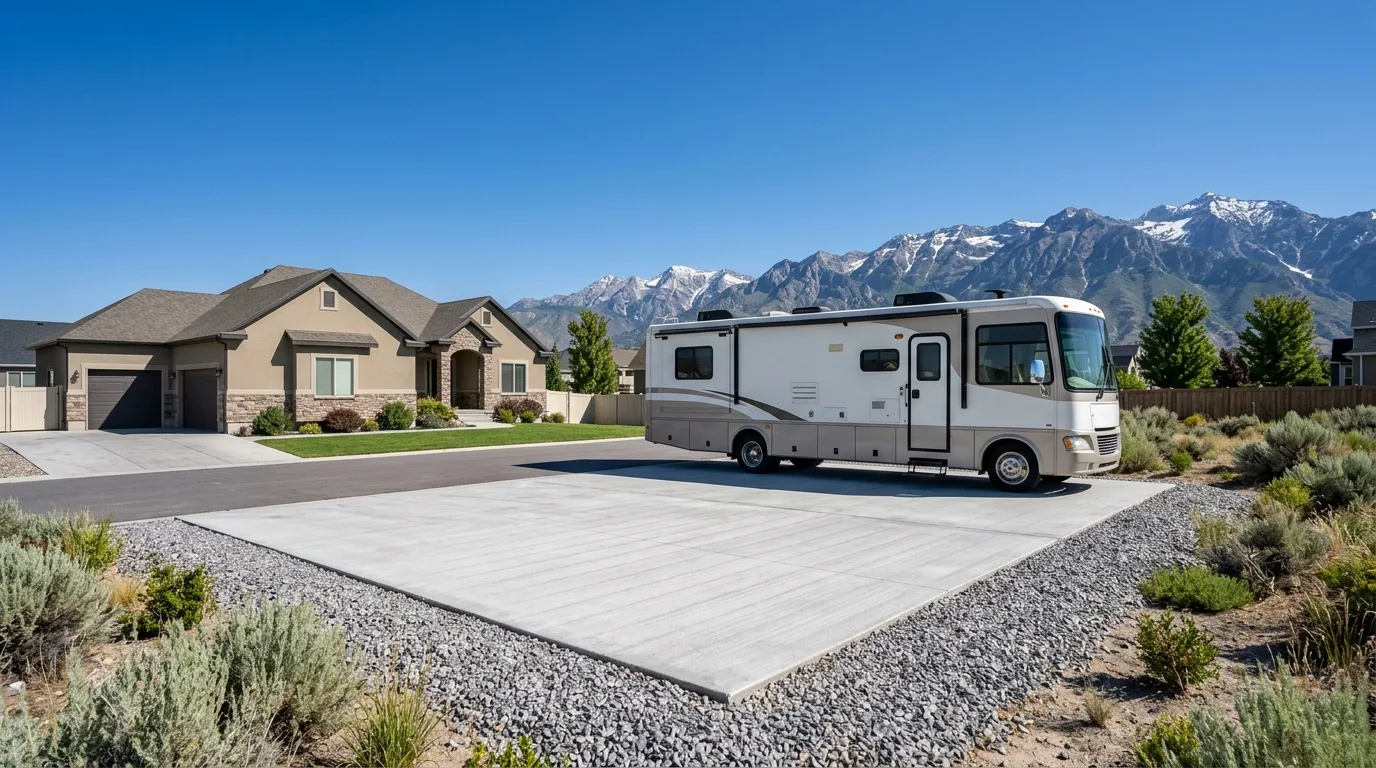
Riverton has one of the highest rates of RV and boat ownership in Salt Lake County — the combination of large lots, easy Mountain View Corridor access, and a culture that values outdoor recreation makes it a natural fit. What many homeowners don’t realize until after the first year is that a standard residential concrete driveway isn’t designed for the weight of a Class A motorhome or a loaded boat trailer. In this post, we cover everything Riverton homeowners need to know about concrete RV and boat parking pads.
Get a Free RV Pad Estimate in Riverton
Call Riverton Concrete at (888) 376-0955 for a written estimate on your RV or boat parking pad.
Why Standard Driveways Fail Under RV and Boat Weight
A standard residential concrete driveway in Riverton is designed for a 4,000-pound passenger vehicle. A Class A motorhome weighs 20,000 to 30,000 pounds fully loaded. A pickup truck with a loaded boat trailer can easily weigh 15,000 to 18,000 pounds. Parking these loads on a 4-inch standard residential slab — especially one poured without adequate subbase on Riverton’s clay-heavy soils — leads to cracking, settlement, and slab failure within a few years.
The issue isn’t just slab strength. Riverton’s clay soils near the Foothills and Rose Creek neighborhoods shift seasonally — swelling with snowmelt, shrinking in summer. A 4-inch slab on minimal base can handle a daily car without visible problems, but the concentrated load of an RV parked in the same spot for weeks applies sustained point loads that accelerate sub-base compression and slab cracking. The solution requires a thicker slab, more robust reinforcement, and deeper base preparation.
Types of RV and Boat Pad Configurations
Side-yard RV pad: The most common configuration in Riverton — a concrete pad alongside the house or garage, accessible through a gate. Typically 12 to 14 feet wide and 40 to 60 feet long depending on RV length. Requires careful grading for drainage away from the foundation.
Rear-yard parking pad: For properties with rear access, a pad in the backyard or behind the garage. Usually paired with a rear gate and concrete approach. Works well for boat trailers and shorter RVs.
Driveway extension: Widening an existing driveway to accommodate an RV or boat in addition to normal vehicles. Requires matching the existing slab grade and reinforcing the joint between old and new concrete.
Tandem RV garage pad: A thickened interior slab for garages designed to house an RV. Requires flat, level grade and smooth finish for indoor parking.
Combined driveway/RV pad: A full-width approach driveway designed from the beginning to accommodate both daily vehicles and RV/boat parking. Most cost-effective when planned during new construction.
Practical Specifications for RV Concrete Pads in Riverton
-
Slab thickness: 5 to 6 inches minimum for RV weight classes. Standard 4-inch residential slabs are inadequate for loads over 10,000 pounds.
-
Reinforcement: #4 rebar on 12-inch centers (versus 18-inch for standard residential) to handle concentrated loads. Some engineers specify post-tensioning for heavily loaded pads on expansive soil sites.
-
Subbase: 6 inches of compacted Class 6 road base minimum. In clay-heavy areas of Riverton, deeper excavation may be required to reach stable bearing soil before placing base material.
-
Concrete mix: 4,000 psi with 6% air entrainment. The air entrainment is especially important for RV pads because the concentrated weight accelerates moisture infiltration and freeze-thaw damage at the vehicle contact points.
-
Slope: 1/8 to 1/4 inch per foot away from the structure for drainage. Standing water beneath an RV accelerates soil saturation and slab damage.
Planning an RV or Boat Pad in Riverton?
Riverton Concrete provides complete RV pad solutions — design, permits, and installation. Call (888) 376-0955.
How RV Pad Installation Works
Installation begins with a site visit to assess access, drainage, and soil conditions. We review applicable permit requirements — in Riverton, a concrete pad that supports an accessory structure may require a permit, while a standalone parking pad typically does not. Lot-specific soils reports are required on Riverton new dwelling permits but may not be required for a standalone RV pad depending on scope.
After permits are confirmed, excavation begins. We excavate to the required depth — 12 to 14 inches below finished grade for a 6-inch slab on 6 inches of base, plus 2 to 4 inches additional for sites requiring deeper base work. After compaction and base preparation, forms are set with proper slope and reinforcement is placed. A 5 to 6-inch pour of 4,000 psi air-entrained concrete is placed, finished with a broom texture for traction, and sealed after cure.
Cost of Concrete RV Pads in Riverton
RV and boat parking pads in Riverton cost $8–$14 per square foot for a 5 to 6-inch reinforced slab with proper base preparation — higher than standard residential driveways due to increased slab thickness and reinforcement. A 14 x 50-foot RV pad (700 square feet) typically costs $5,600–$9,800.
Demolition of an existing surface adds $4–$8 per square foot if needed. Sites requiring extra excavation depth or base material due to poor soil conditions add cost. Comparing across Salt Lake County, Herriman and Bluffdale pricing for RV pads is similar to Riverton given comparable soil conditions.
Frequently Asked Questions
Does an RV pad require a permit in Riverton, Utah?
A standalone concrete pad for vehicle parking in Riverton typically does not require a building permit. If the pad connects to or supports a covered structure — RV carport, storage building — a permit is required. Riverton City recommends checking the specific use before beginning work. We review applicable requirements during every estimate so you know exactly what applies to your project.
How thick should a concrete RV pad be in Riverton?
Minimum 5 inches for Class B and C motorhomes and loaded boat trailers. Six inches is recommended for Class A motorhomes over 30,000 pounds. The additional thickness is most critical at the wheel contact points where sustained concentrated loads are highest.
How long will an RV concrete pad last in Salt Lake County’s climate?
A properly specified 5 to 6-inch reinforced RV pad with compacted base and air-entrained concrete should last 30 to 50 years in Riverton’s climate. The main threats are freeze-thaw cycling and de-icing salt. Seal the pad before the first winter and reseal every 2 to 3 years. Keep de-icing salt away from the slab surface whenever possible.
Build a Concrete RV Pad That Handles Utah Winters
Call Riverton Concrete at (888) 376-0955 for a free RV pad estimate in Riverton or Salt Lake County.
Related: