Concrete Staining vs. Stamping: Which Finish Is Right for Your Home?
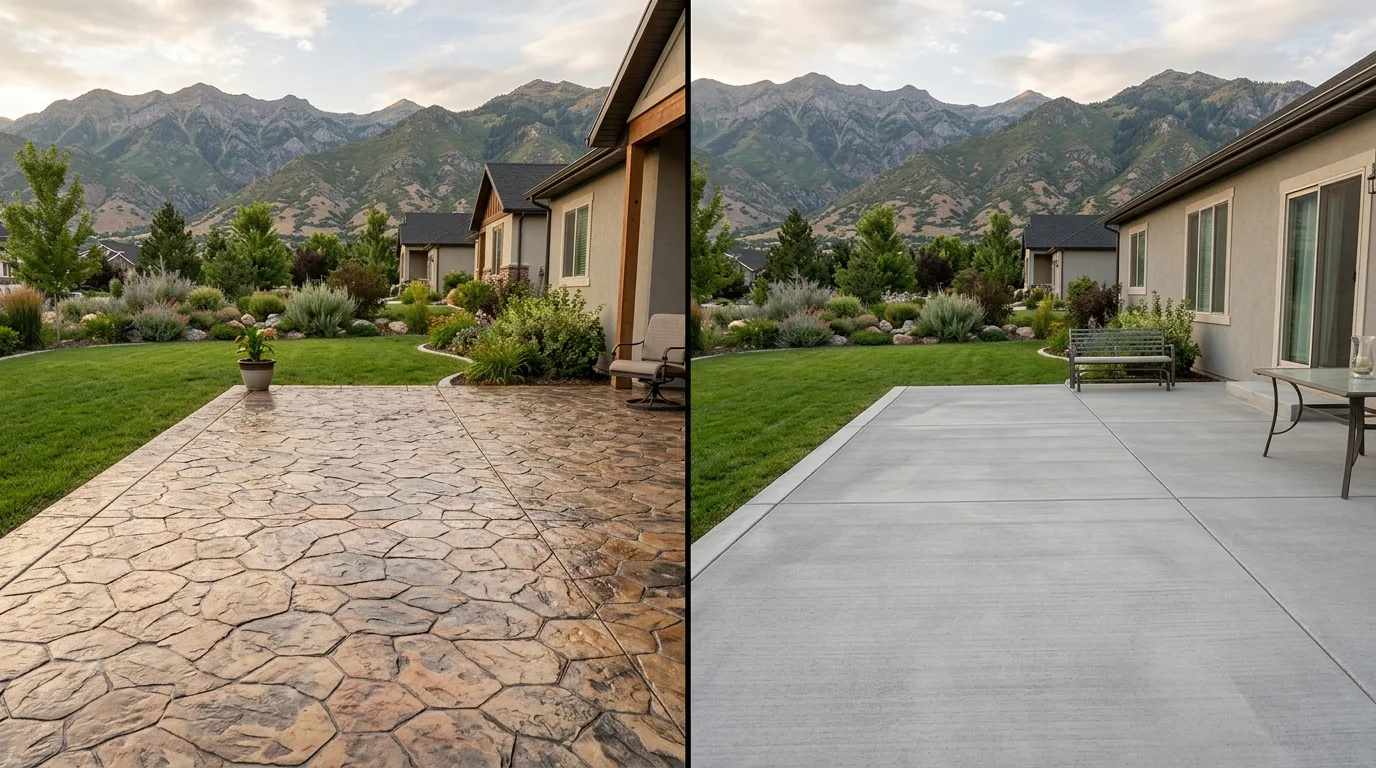
Both concrete staining and stamped concrete transform a plain gray slab into something visually interesting — but they work in completely different ways and produce different results in Riverton’s climate. Here’s how to decide which is right for your project.
Get a Decorative Concrete Estimate in Riverton
Call Riverton Concrete at (888) 376-0955 for a free consultation on stamped or stained concrete options.
Why the Staining vs. Stamping Decision Matters in Riverton
Both staining and stamping are applied to existing or new concrete surfaces, but they address different goals. Stamped concrete adds texture and pattern to fresh concrete during installation — it replicates the appearance of natural stone, brick, or wood. Acid staining or reactive staining adds color to existing concrete by chemically reacting with the cement paste — it produces a mottled, variegated color effect that looks organic and earthy, but does not add texture.
In Riverton’s freeze-thaw climate, both systems require quality sealer maintenance to perform long-term. But the preparation requirements and failure modes are different, and the right choice depends on what you’re trying to achieve and the condition of your existing concrete.
Types of Concrete Staining
Acid stain (reactive stain): A solution containing hydrochloric acid and metallic salts that reacts chemically with the calcium hydroxide in concrete to produce earthy tones — browns, rusts, golds, and greens. Creates a mottled, translucent color effect that is unique to each pour. Cannot be applied to stamped concrete that has been treated with release agent. Permanent once applied — cannot be fully removed if you dislike the result.
Water-based concrete stain: Acrylic-based colorant that penetrates the concrete surface. Wider color range than acid stain, including blues, reds, and bright colors that acid stain can’t achieve. Semi-permanent — color fades over time without sealer maintenance. Easier to apply and less chemically aggressive than acid stain.
Concrete dye: Ultra-fine colorant particles that penetrate deeply into the concrete surface. Fast application, very wide color range, excellent UV resistance when sealed with quality topcoat. Popular for interior applications and covered exterior areas.
Types of Stamped Concrete
Standard single-pattern stamp: One pattern type across the full slab. Most common for patios and driveways. Cobblestone, flagstone, and ashlar slate are the most popular in Riverton’s market.
Multi-pattern with border: A different pattern in the field versus the perimeter border creates visual interest and frames the space. Adds complexity and cost.
Stamped with staining: Some decorative concrete projects combine stamped patterns with acid or water-based staining for additional color variation. The release agent application during stamping contributes its own color effect, so additional staining is typically done selectively.
Practical Considerations for Each Approach in Riverton
-
Applying stain to existing concrete: Concrete must be clean, unsealed, and free of coatings. Many older Riverton driveways and patios have been sealed previously — stain cannot penetrate through existing sealer. Professional assessment needed before proceeding.
-
Stamped concrete on new pours: The ideal application. Stamping happens during installation — the pattern is as durable as the concrete itself, not a surface treatment. Best for patios, walkways, and decorative driveways in the Rose Creek and Western Springs areas of Riverton.
-
Repair and color matching: Stained surfaces are very difficult to match if a section cracks and needs repair. The acid staining reaction varies by concrete batch and age. Stamped concrete section replacement is easier to match because pattern stamps and color hardener formulas are consistent.
-
Maintenance in Riverton’s climate: Both require regular resealing — every 2 to 3 years for stamped surfaces with acrylic sealer, every 3 to 5 years for stained surfaces with penetrating sealer. Riverton’s UV exposure at 4,439 feet elevation accelerates sealer degradation on both systems.
-
Cost comparison: Staining an existing slab runs $3–$8 per square foot depending on preparation needs and system type. Stamped concrete on a new pour runs $10–$18 per square foot complete. If you have an existing slab in good condition, staining is significantly more cost-effective than demolition and replacement with stamped concrete.
Discuss Your Riverton Decorative Concrete Options
Call Riverton Concrete at (888) 376-0955 for a free consultation on staining or stamping.
How Each Process Works
Staining process: Surface preparation is critical — the concrete must be mechanically abraded or acid-etched to open the surface pores for stain penetration. The stain is applied with a sprayer or brush and left to react for 2 to 8 hours for acid stain, or allowed to penetrate for 30 to 60 minutes for water-based stains. After neutralizing acid stain with a baking soda and water solution, the surface is sealed with a compatible topcoat.
Stamped concrete process: Color hardener is applied to fresh concrete and floated in, followed by release agent. Stamping mats are pressed into the plastic concrete surface in a coordinated pattern. After curing, release agent residue is washed off, surface is detailed, and sealer is applied. The stamping window is time-critical — temperature conditions in spring and fall give the best working time in Riverton.
Cost Comparison: Staining vs. Stamping in Riverton
Staining an existing 400-square-foot patio: $1,200–$3,200 depending on preparation and system type.
Stamped concrete on a new 400-square-foot patio: $4,000–$7,200 complete including base prep, concrete, stamping, and sealer.
If the existing slab is in good structural condition, staining offers significant cost savings. If the slab is deteriorated and replacement is warranted, stamped concrete is the right choice for the new installation.
Frequently Asked Questions
Can I stain my existing Riverton driveway?
Yes, if the driveway is in good structural condition and has not been previously sealed. Heavily worn, scaled, or oil-stained concrete may not stain evenly — the stain follows the concrete’s existing condition. A professional assessment determines whether staining is viable for your specific driveway.
Does stained concrete hold up to Utah winters better or worse than stamped concrete?
Stamped concrete with quality color hardener and penetrating sealer performs somewhat better in Riverton’s freeze-thaw climate because the color is integral to the slab, not just on the surface. Stained concrete exposed to de-icing salt can lose color vibrancy faster without frequent resealing. Both systems require the same fundamental protection: air-entrained concrete base and regular sealer maintenance.
Which looks better — staining or stamping?
This is subjective, but staining tends to produce organic, earth-toned effects that suit natural and rustic aesthetics. Stamping produces defined patterns that suit traditional, craftsman, and contemporary styles. For Riverton’s market, stamped cobblestone and flagstone are particularly popular because they complement the natural landscape of Salt Lake County. Read our full stamped concrete guide for pattern and color options.
Transform Your Riverton Concrete Surface
Call Riverton Concrete at (888) 376-0955 for a free consultation. Staining and stamping available throughout Salt Lake County.
Related: